
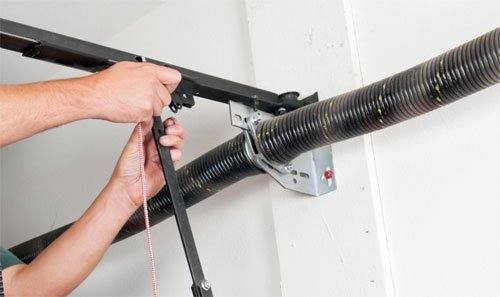
A broken garage door spring usually shows up as a loud bang, a door that feels twice as heavy, or an opener that stalls partway up and reverses. The spring itself may show a visible gap in the coil. These signs point to a spring that has lost its tension and can no longer help lift the door safely. Catching them early, and calling for an inspection, keeps a simple spring job from turning into repairs on cables, rollers, or the opener as well.
A visible gap in the spring
Look up at the top of the garage door, above the door itself, and you may see the torsion spring stretched across a metal shaft. If it has snapped, you will see a gap in the coil, sometimes with the two ends pointing in different directions. This is one of the clearest signs of a broken spring, and it is easy to spot in daylight or with a flashlight.
A gap like this means the spring lost its tension entirely and can no longer help lift the door weight. Do not try to close the gap yourself or force the door open. The remaining tension in a broken spring can release suddenly, and that is dangerous. Call for an inspection so a technician can assess the shaft, cable drums, and center bracket before any work starts.
The door suddenly feels heavy
If your garage door used to lift with one hand and now feels like dead weight, the spring is likely doing little or nothing to counterbalance the door. Springs are engineered to offset most of a door's weight, sometimes 300 pounds or more on a two car door, so when one fails, you feel the difference immediately.
This heaviness also puts strain on the opener, the drive gear, and the cables. Running the opener repeatedly against a bad spring can burn out the motor or snap a cable under load. If lifting the door manually feels noticeably harder than it used to, stop using the opener until a technician checks the spring and related hardware.
The opener lifts only a few inches
An opener that raises the door a short distance, then stalls or reverses, is often fighting a spring that no longer shares the load. The opener motor is not built to lift the full weight of the door on its own, so it strains, trips its safety limit, and stops partway.
This is not an opener problem you can fix by adjusting the travel limits or force settings. Doing so can mask the real issue and push the motor harder, which risks damage to the opener itself. The fix is addressing the spring, not reprogramming the opener.
Why waiting to fix a broken spring costs more
A broken spring rarely stays a simple problem. Once one spring fails, the second spring on a two spring system is usually close behind, since both springs see the same number of open and close cycles over the years. Waiting after the first failure often means paying for two springs instead of one.
Continued use also stresses the cables, rollers, and opener drive system, since they are absorbing weight the spring should be carrying. A spring job that starts in the $150 to $450 range can turn into a larger bill that also includes cable repair or roller replacement if the door keeps operating under strain.
What determines the cost of spring replacement
Spring replacement cost depends on the type of spring, torsion or extension, the number of springs needed, the wire size and length required for your door's weight, and whether the cable drums or center bracket also need attention. Heavier doors, including many two car garage doors, use larger springs that cost more.
Access also plays a role. A standard residential setup with a clear working area is quicker to service than a high ceiling or an unusual door configuration. Commercial doors with heavier springs fall into a separate pricing range because of the larger equipment and higher spring tension involved.
A simple spring swap at the low end and a two spring job at the high end
At the low end, a single torsion spring replacement on a standard residential door, with no other worn parts, typically runs $150 to $250. This is common on lighter doors where only one spring failed and the rest of the hardware is in good shape.
At the high end, replacing both torsion springs on a heavier insulated door, along with worn cable drums or bearings that are due for replacement at the same time, can run closer to $450. Commercial doors with high cycle springs push costs further, which is why they fall under a separate commercial repair range.
In most cases spring failure calls for repair, not a new door. Replacing the whole door only makes sense if the panels, tracks, or opener are also failing at the same time, or if the door is old enough that parts are hard to source.
What a proper quote should include and warning signs when a quote looks too low
A proper spring replacement quote should state the spring type and size, whether one or two springs will be replaced, whether cable drums or bearings are included, the labor cost, and the total price before any work begins. It should also note the warranty coverage on parts and labor.
If a quote looks unusually low, it often leaves out parts that will surface as add-ons later, such as drums, bearings, or the second spring. A fair price reflects the full scope of the job up front, not a bare minimum number meant to get a technician in the door.
- A price given over the phone with no inspection of the door
- No mention of spring type, size, or how many springs will be replaced
- A quote that skips the cables, drums, or bearings entirely
- Pressure to approve work before the technician explains the options
- No warranty mentioned on parts or labor
What you can check yourself, and how the visit works
Before calling, you can safely look at the spring above the door in daylight and check for a visible gap or separation. You can also note whether the door feels heavy when lifted by hand with the opener disconnected, and whether the opener stalls at the same point every time. Write down what you see and hear.
Do not touch the spring, the cables, or the center bracket, and do not attempt to adjust or remove the spring yourself. These parts hold significant tension and are not safe to handle without the right tools and training.
When a technician comes out, expect a full inspection of the door system, not just the spring, since worn cables or rollers often need attention at the same time. The technician explains what is wrong, walks through the options, and confirms the exact price before any approved work begins. Same day appointments are available when the schedule allows, and covered repairs carry a 12 month warranty. You can also reach the office directly at (214) 307-6420 to ask questions before scheduling.
Frequently asked questions
Can I replace a garage door spring myself?
It is not safe to do without the right tools and training. Torsion springs hold significant tension and can cause serious injury if handled incorrectly. A technician has the bars and clamps needed to release and reset that tension safely.
How long does spring replacement take?
Most standard residential spring replacements take about one to two hours once the technician is on site, though the exact time depends on the number of springs and whether other parts need attention at the same time.
Will my garage door opener need repair too if the spring breaks?
Not always, but running the opener against a broken spring can strain the motor and gears. A technician checks the opener during the visit to see if it absorbed any damage before the spring was replaced.
Do both springs need to be replaced at once?
Not necessarily, but many technicians recommend replacing both springs on a two spring system together, since they wear at a similar rate and the second one often fails soon after the first.
What areas does Garage Door Reaper serve?
The office is based in Plano at 1008 Ridgefield Dr, and technicians serve homeowners and businesses across roughly 100 cities in the Dallas Fort Worth area.