
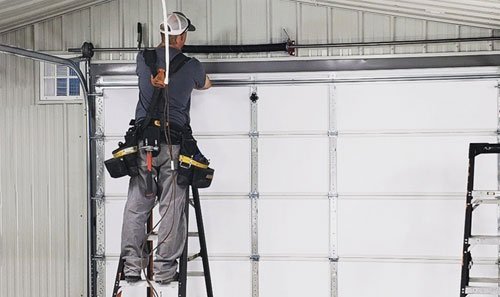
Most commercial garage door spring repairs in the Dallas-Fort Worth area fall between $250 and $1,500. The low end covers a single torsion spring swap on a standard steel door. The high end covers heavy-duty springs on large industrial doors, multiple spring systems, or jobs that need a lift or extra labor. The exact price depends on door size, spring type, cycle rating, and whether the rest of the system needs attention while the technician is already there.
What drives the cost of a commercial spring repair
The biggest factor is the door itself. A standard steel sectional door on a small office or retail bay uses lighter springs than a large warehouse or loading dock door that weighs several hundred pounds more. Heavier doors need springs rated for more weight and more daily cycles, and that pushes the price toward the higher end of the range.
Spring type also matters. Torsion springs mounted above the door are more common on commercial doors and usually cost more to replace than extension springs, but they last longer and handle heavier doors more safely. Cycle rating, which measures how many times a spring is built to open and close before wearing out, changes the price too. A high-cycle spring built for a door that opens dozens of times a day costs more than a standard residential-grade spring.
A lower-cost job and a higher-cost job, and what separates them
A lower-cost job usually looks like a single torsion spring replacement on a standard steel door that opens and closes a normal number of times a day. The technician has easy access, the cables and rollers are in decent shape, and the job is done within an hour or two. This scenario tends to land near the bottom of the $250 to $1,500 range.
A higher-cost job usually involves a large industrial door with two or more high-cycle torsion springs, worn cables or drums that need replacing at the same time, and a door that sees heavy daily use. Doors mounted high above a loading dock or in a space with limited clearance can also add labor time, since the technician needs extra equipment to reach and safely handle the springs.
What a written quote should spell out
A proper quote is not a single number pulled out of the air. It should list the exact parts going into the door, the labor involved, and any other repairs the technician found during inspection. That way you know what you are paying for before any work starts, not after.
Every quote we give also states what is covered under the 12-month warranty on the work performed, so there is no confusion later if something needs a follow-up visit.
- Spring type and cycle rating being installed
- Number of springs being replaced
- Parts cost and labor cost listed separately
- Whether cables, drums, or bearings also need replacement
- Warranty coverage on parts and labor
- Total price confirmed before any work begins
Warning signs in a quote that looks too low
A price given over the phone without anyone looking at the door is a common red flag. Commercial doors vary too much in size, spring type, and condition for a fair number to be assigned sight unseen. If a quote comes in far below the typical range and no one has inspected the door, expect the final bill to change once a technician actually shows up.
Other warning signs include a spring size that does not match the door weight, no mention of warranty coverage, and pressure to pay in full before the work is finished. A legitimate quote explains what is being installed and why, and it holds up once the technician is standing in front of the door.
When spring repair makes sense and when the door needs more work
If the door itself is in reasonably good shape, meaning the tracks are straight, the panels are not damaged, and the opener is working fine, spring repair is usually the right call. Replacing a worn or broken spring restores normal operation without touching anything else, and it is the most common repair on commercial doors of any age.
Replacement of the whole door starts to make more sense when springs have failed more than once in a short period, when the door has significant rust or panel damage, or when the tracks and rollers are worn enough that a new spring would just be masking a bigger problem. At that point, spending on repeated spring fixes stops being the better value compared to a new door installation.
What a business owner can check and what to leave alone
Before calling for service, it helps to note what you are seeing or hearing. A door that is noticeably harder to lift by hand, a loud bang from the garage, or a door that looks lopsided when it opens are all useful details to pass along. You can also do a visual check for a visibly broken or separated spring coil above the door, since that is easy to spot without touching anything.
What you should not do is attempt to adjust, remove, or release tension on a commercial spring yourself. These springs are under heavy load and can cause serious injury if handled without the right tools and training. Leave the actual spring work, and anything connected to it like cables or drums, to a technician.
How the inspection and price confirmation work on site
When a technician arrives, the first step is inspecting the whole door system, not just the spring that is obviously broken. That includes the cables, rollers, tracks, and opener, since a failed spring often puts extra strain on those parts. The technician explains what is found and what options exist, whether that means a straightforward spring swap or a larger repair.
Once everything has been checked, the technician confirms the price with you before any approved work begins. Same-day appointments are available when scheduling allows, so a broken spring on a commercial door does not have to sit unfixed for long. If you want to talk through a repair before booking, you can reach us at (214) 307-6420.
Why waiting on a bad spring costs more later
A broken or badly worn spring puts extra strain on the cables, opener, and rollers every time the door tries to move without proper support. What starts as a single spring problem can turn into a cable snap, opener burnout, or rollers grinding off the track if the door keeps getting used in that condition.
For a commercial property, a stuck or unsafe door also means lost time for deliveries, employees, or customers, and a bigger safety risk if the door drops unexpectedly. Addressing a bad spring early usually keeps the repair in the lower part of the price range, while waiting tends to add more parts and more labor to the final bill.
Frequently asked questions
How much does it cost to replace a commercial garage door spring?
Most commercial spring replacements in the Dallas-Fort Worth area cost between $250 and $1,500. The price depends on the door size, spring type, cycle rating, and whether other parts like cables or drums need attention at the same time.
Do both springs need to be replaced if only one is broken?
On doors with a torsion spring pair, many technicians recommend replacing both since the second spring is usually close behind in wear. This is not always required, and the technician will explain the tradeoffs before confirming the price.
How long does a commercial spring replacement take?
A single spring swap on a standard door usually takes one to two hours. Larger doors with multiple high-cycle springs, or doors needing extra access equipment, can take longer, which the technician will outline during the visit.
Is commercial spring replacement covered by any warranty?
Yes, spring replacement work is covered under our 12-month warranty. If a covered issue comes up after the repair, we address it as part of that warranty period at no extra cost for the covered parts or labor.
Can I replace a commercial garage door spring myself?
No. Commercial springs are under heavy tension and can cause serious injury if handled without the right tools and training. This is a repair that should always be left to a technician with the proper equipment.